Sunday, 24 August 2014

Deep Breath


Right off the bat the theme music is all different and as are the titles.  They look great, I'm not so taken by the music.  Maybe it's my TV, but it seemed more tinny than ominous or deep in sound.  But between the pre-titles and opening minutes, there's plenty of excitement and interest as the new Doctor starts to show some of his new personality.  Loud, somewhat abrasive, energetic.  I think it's important that the Doctor is in contrast to his previous self.  Matt Smith's Doctor was too much like David Tennant at the beginning, he started to become his own later on but broadly there was too much similarity.  That cannot be said of Capaldi's Doctor in this.

The dinosaur seemed a bit of a waste.  It did nothing and soon died, it seems included as a gimmick to advertise the story on the TV trailers rather than serve much purpose in the story.  Also it was the size of Godzilla, it stood as tall as Big Ben and could swallow and regurgitate the Police Box with no trouble.  It was definitely identified as being from prehistoric Earth but was impossibly large.  Either they have or haven't the budget to do dinosaurs in London properly.


Moffat was indulging himself again, littered with reference to previous stories written by himself, and full of his own characters.  Vastra and company are rather superfluous, they are there to stretch out the story by half an hour and do the same jokes.  Yes, we know Strax doesn't get human biology and there is lots of inscrutable cleverness from Vastra, plus waving some swords around and a lesbian kiss.  I'm pretty bored of these characters now and Moffat insists on pushing them in continually.  Talking of Moffat rehashing old ideas and themes, this episode was 'don't breathe' instead of 'don't blink'. Really?  What next?  Monsters you have to put your fingers in your ears to overcome?

Most of these distractions got in the way of enjoying the new Doctor, who was clearly the best thing in the programme.  A smaller more personal story with Clara and the Doctor would have worked better I think, this was over long to accommodate Vastra and team not to give the Doctor more screen time.  Capaldi was hugely enjoyable in the part with his wild, but not pantomime, performance and the craziest eyes since Tom Baker.  The robot threat was pretty small potatoes it seems.  Obviously the Doctor couldn't let it go on with them murdering people for body parts, but it works as the story is giving Capaldi time to lay the groundwork for his Doctor.  The scene in the alley was my favourite, with a particularly haywire Doctor demanding the tramp hand over his coat.  Things really start to work once he meets Clara at the restaurant.  The way the characters play off each other here is at the episode's best which is why I feel the story didn't need the inclusion of so many others.

"I stole this off a tramp.  Don't smell.  You won't gag if you don't smell"
Did the Doctor push the robot or did he jump?  In an attempt to darken the series, we'll likely never know.  But it's not without precedent, if it was the 1st Doctor, he would have pushed him.  Hartnell's Doctor was a killer, see him throw an assassin from a first floor window in The Romans, or hitting a man over the head with a shovel in Reign of Terror. Tom Baker's Doctor gassed Solon with cyanide.  Also playing with cyanide was Colin Baker's Doctor when he killed Shockeye in the Two Doctors.  It's not a new thing, but I hope it doesn't become a theme as fundamentally the Doctor is a good person who kills only as a last resort and clearly finds it regrettable afterwards.

Overall, pretty good but too long given the material.  It was long because there were too many characters needing screen time, when this episode was about the Doctor and Clara rediscovering him after regeneration.  Capaldi was ace, I think we all agree on that.

Sunday, 17 August 2014

VHS Memories of Doctor Who

Currently we're reaching the end of our Pertwee one-episode-a-night marathon, and I am close to putting all the Pertwee DVDs in order on a shelf barely more than a foot long.  Two thoughts come to mind.  Firstly, that if it were not for the express purpose of watching all the Pertwee's in order, I would never have thought to purchase a number of them, such as Colony in Space and Death to the Daleks, but I'm glad for having done so.  Secondly, that the entire era takes up so little space, approximately 14".  VHS on the other hand filled my bedroom as a child, I had no where near the full set and they filled an entire bookcase even when doubled up.  They're all gone now, as the DVDs came out they were much easier to store, they had numerous features, the image quality was significantly higher in many cases.  I no longer owned a video player, there was just no point to VHS.  In the end I sold most of them to some eager young Dr Who fans at a car boot sale for 50p each, they went to a good home.  So many VHS cassettes have ended up in landfill, I hope these were watched at least once more.

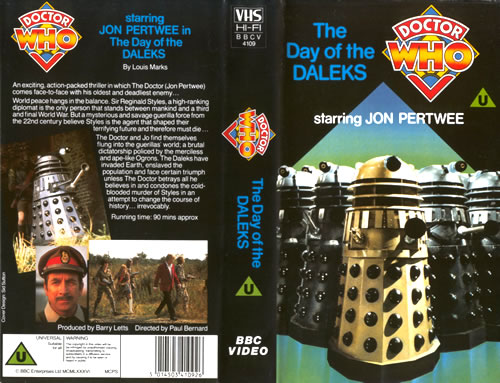
False advertising?  The story only has three Daleks, one of which was gold.  For years the cover persuaded me that there were more. 
Aged about five my Dad bought me my first Doctor Who on VHS.  I can't remember which came first, it was either Day of the Daleks or The Daleks.  After this I probably had Death to the Daleks, followed by Revenge of the Cybermen and the Time Warrior and other early videos, likely Robots of Death, Seeds of Death.  One thing common to most of these early releases is that they were omnibus editions, with the episode breaks removed.  This seemed preferable at the time, but on reflection Doctor Who loses a lot from the episodes not being bookended with the cliffhangers.  Stories also benefit from being watched episodically, as my Pertwee marathon has found, in a single viewing many come off for the worse being a drawn out slog.


The Daleks was a bit odd in that it came in two cassette boxes, one black and white, the other the same in sepia tones.  Almost all double videos afterwards came in a double sized box.  The Daleks I recall was gripping stuff, aged five I loved every minute, the black and white didn't faze me one bit. My dad's comment since was that I used to enjoy the radio a lot as a child and that I probably didn't notice the lack of colour.  While colour TV was obviously the norm when I was a child 25 years ago, it typically wasn't that good by todays standards, which are a sensory overload of colour and CGI.  I wonder if I was unusual as a child, or whether young children today really are less receptive of black and white TV.  The Hartnells were only 25 years old then as compared to 50 years now, maybe the gulf has expanded more than I appreciate.
Unlike those other early VHS releases the Daleks was episodic, but had other edits.  Such as the story ending with the crew in the Tardis and fading to credits.  The cliffhanger of an explosion rocking the Tardis leading into Edge of Destruction wouldn't be restored until a much later release.  This edit was made so as to make the story seem a complete a more complete entity, and not to have a confusing end.  As with the episode breaks, I think people generally prefer the complete package.

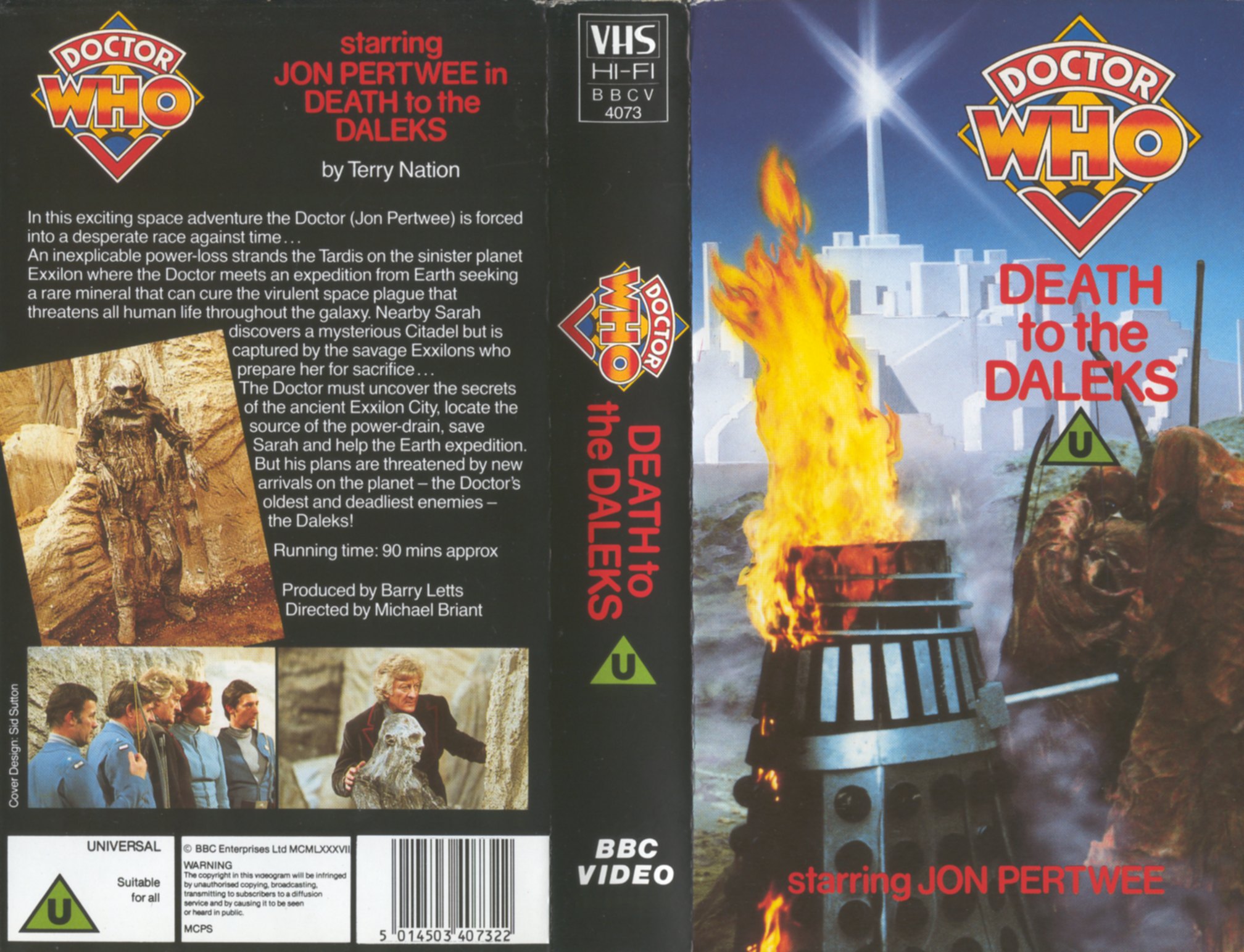
The iconic moment of Death to the Daleks largely because the exploding Dalek picture was so widely published in early Doctor Who material.  Used again on the one of the most memorable Target novels.
I'm fairly sure my third VHS was Death to the Daleks. There's certainly a bias towards Dalek stories as clearly they thought that's what the public wanted, and that's what I was bought. They could have chosen better stories, but it's short and has Daleks. BBC Video seemed to avoid anything beyond Tom Baker at this time as well, it would be some years before Remembrance of the Daleks or Earthshock were released despite having major monster appeal.  I distinctly remember being more frightened of the Exillons than the Daleks.  It's a surprise it took so long for them to release Genesis of the Daleks, that was a real treat on VHS.  That had a radio release and is the most repeated story by BBC TV.  Note when they started to repeat old Doctor Who some time in the 1990s, starting with Spearhead they only got as far as Silurians.  Then some BBC boss decided that it wasn't doing well enough so decided it should skip to something obviously popular to get ratings.  Most popular Doctor, Tom Baker, most popular monster, Daleks obviously, thus Genesis was repeated yet again.  Everyone had already seen it or bought it by this point.

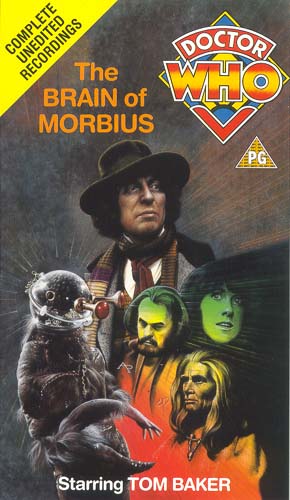
I had Revenge of the Cybermen a bit later which was a novelty as the only available Cyberman story.  The alternatives were a bit thin on the ground, even if they delved into the 1980s only Earthshock would have been suitable, Attack and Silver Nemesis are just awful continuity-fests best avoided by anyone.  Revenge was the first story to receive an exorbitantly priced home release in 1983 on Betamax, Laserdisk and VHS (with an Earthshock Cyberman).  1984 saw an absurdly butchered release of Brain of Morbius with an hour long running time.  By the time I came to the videos, they were being released for a sensible price, around £10 and often cheaper.  Revenge was quite entertaining aged six or so and my first exposure to Tom Baker's Doctor.  Baker's Doctor spooked me quite a bit, like other children of the 70s I imagine. The scene with the Doctor controlling the Cybermat to force information from Kellman made me uncertain that Tom Baker's Doctor was supposed to be the good guy.  I didn't know where he would draw the line.


Various things scared me in these stories available on early VHS, though perhaps not all the most obvious things.  The two most frightening were Brain of Morbius and Death to the Daleks.  As mentioned, the Exillons were fairly frightening, the story opens in the dark with Sarah especially vulnerable in a marooned, 'dead' Tardis.  The loss of that safe haven really does make it seem more frightening, in a normal story there's always the security of being able to flee back to the Tardis.  The crew rarely do, but it's a comfort that's always there.  That's something that Death to the Daleks actually achieves beyond its many other faults.  TO be clear, after the mid way point of episode one it becomes a lot less scary for the most part.  Brain of Morbius is similarly scary for being dark and creepy.  In that case, I was mostly scared of the Sisterhood oddly enough.  Other frightening moments include Harry attempting to stab Sarah with a pitchfork in Terror of the Zygons, the same story in which the world's scariest and bloodstained nurse stoves a soldiers head in with a huge rock.

As years went by the VHS range became more complete and the price crept up.  Not unreasonably, but one source of contention was the pricing of double video packs.  These seemed contrived for the purpose of charging far more money.  Unlike DVDs, little or no restorative work was done on the majority of VHS releases so the running time costs could not have impacted the RRP that much.  Talons of Weng-Chiang was first released on a single VHS cassette proving from the beginning that six episodes could be put on a single release.  Much later in the VHS range, the Daleks was re-released on a single cassette, all seven episodes together.  However, early on it became the norm to split six episode stories across two cassettes in a bigger box and charge £20 for a single story rather than £10.  This is the reason that I didn't have many of theses six episode stories, it's was more expensive given the content and the box was unnecessarily about the size of a house brick.


Charging double for stories with six episodes got just a bit silly with the release of Shada.  Undoubtedly there were costs involved, but the linking material was scant and ultimately you ended up with piecemeal material for six episodes that barely added up to four episodes.  Further was the revelation that, exciting as a never previously seen 'lost' story was,  Shada just wasn't very good at all.  It's been somewhat fetishised since with multiple attempts to 'complete' it.  The New Zealand fan club published a fan novel, Gareth Roberts recently wrote a novel, Big Finish did an audio/webcast and Ian Levine even produced an animated 'reconstruction' with some questionable voice acting.  You'll thankfully have to arrange a private viewing to see this last delight.

Back to the original point, the story cuttings with some linking material by Tom Baker was released on VHS at £20.  The double boxset was justified by the inclusion of a script book which I doubt anyone ever sat down to read.  The 'scriptbook' style font was wearing on the eyes, my copy was especially stiff with coarse paper and the diamond logo-shaped hole in the cover didn't help for easy reading either.  Also the book was much slimmer than a VHS, so everything rattled around inside the double cassette box which defeated the point of having a protective case.

Other boxsets were somewhat more interesting but difficult to store as they came in a variety of metal tins and rather highly priced.  Trial of a Timelord came in a large Tardis tin, which I kept after discarding the redundant VHS tapes.  If you desired consistency in the VHS designs you were in for disappointment.  The DVD are mostly uniform and do look smart when lined up together.  The VHS releases started with the diamond logo sideways on the sleeve, but later on turned upright, and then the logo changed entirely after the McGann TV movie was released and the BBC decided everything must have the Pertwee/McGann logo.  Also with all these boxsets, you ended up with things in tins or in paper sleeves rather than plastic cassette boxes, it all looked a jumble.

If you never saw this for sale..
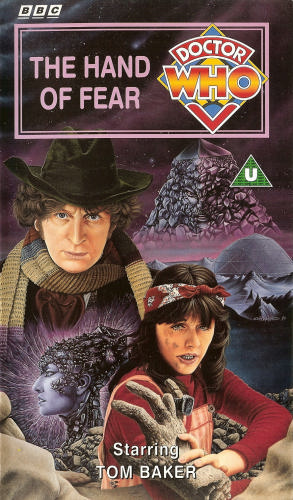
Which brings me to another oddity.  The Hand of Fear was for years the most valued of the VHS range.  Simply it was the last release prior to the TVM, at which point the BBC decided nothing could have the diamond logo and it was promptly deleted from the catalogues.  I didn't seen Hand of Fear until it came out on DVD, as did many others I imagine, I simply never saw it for sale other than second hand for about £30.  Once the DVD came out it was worth pennies overnight.

As previous described the black and white of early stories didn't bother me as a child, no did the overall picture quality, which was atrocious on some releases.  The Restoration Team have worked wonders on the DVD range.  Recolourisation techniques have improved greatly, Claws of Axos looks good on DVD and Terror of the Autons looks gorgeous.  The original VHS releases were very blurry and fuzzy by comparison, it only becomes so apparent after having seen the DVD release.  Ambassadors of Death was a very late DVD release and ended up a curious combination of black and white, and colour footage.  Episodes would change from one to the other mid way through, the DVD is colour throughout.  It's not perfect by a long way but it greatly appreciated, as is the entire colourisation of Mind of Evil and part one of Invasion of the Dinosaurs.  The Dæmons was recoloured in 1993, and then cleaned up even more for DVD.


A stand out moment in the VHS range was the return of Tomb of the Cybermen.  The importance of this find seemed to enter the mainstream, it was featured in newspapers at the time and went on it be one of the biggest selling of the VHS range.  This was in spite of it being rushed to production and looking rough as hell.  The DVD release is a huge leap in quality.  Be careful what you wish for, a lot of fans seemed disappointed that the classic didn't live up to the mythical hype.  A similar reaction was more recently seen with Web of Fear.

As the VHS range wore on I had less and less.  This was for several reasons; I seemed to have many of the best ones, added to which I had seen a large number of the remaining stories recorded by a family friend from UK Gold.  Lastly, they were getting more expensive, whereas I had got earlier releases for as little as £8, they were now £14 as standard.  By comparison, the DVDs now are widely available for £6-7 a few months after initial release even in shops like Forbidden Planet.  They're always available, unlike the VHS that appeared for a matter of months before drying up and being unavailable.


UK Gold has its own sets of memories.  In the earliest days they only seemed to show the black and white stories on a loop.  The person recording the stories occasionally had issues with his reception and the already ropey quality of the Hartnell's was compounded by a snowstorm of interference.  The Web Planet, which is supposed to look like it's filmed through a layer of vaseline, was almost unwatchable.  Later on they started showing the stories in colour, and later they only showed the colour stories and excluded the Hartnells and Troughtons, just looping from Pertwee to McCoy.

UK Gold sometimes did odd things to mess up the schedule.  I distinctly recall watching the Key to Time season for the first time, despite its faults it does get exciting towards the end.  I was hoping for all the loose ends to be tied up but upon receiving the video for that week, it turned out that UK Gold had decided to show Planet of the Spiders in place of the Armageddon Factor.  While I didn't have a copy of this, it was a bit of a disappointment.  The following week was Destiny of the Daleks, meaning Armageddon Factor was skipped entirely.  I didn't get to see the last part of the Key to Time until finding the individual VHS for sale quite some time later.

At some point UK Gold started showing one or two episodes of Blake's 7 before each weekend Doctor Who, and it was then I was able to see that series too.  The VHS releases covered all my earliest years of watching Doctor Who and were mostly focused around the first four Doctors.  In later years I plugged most of the gaps through recordings from UK Gold.  It's a real shame that the BBC have been so reticent to repeat any classic Doctor Who.  Since it's return in 2005, BBC4 have repeated Hand of Fear after Elizabeth Sladen died, Web of Fear part 1 for a themed London Underground night, and Unearthly Child for the 50th anniversary.

Tuesday, 8 July 2014

Frontier Breakout!

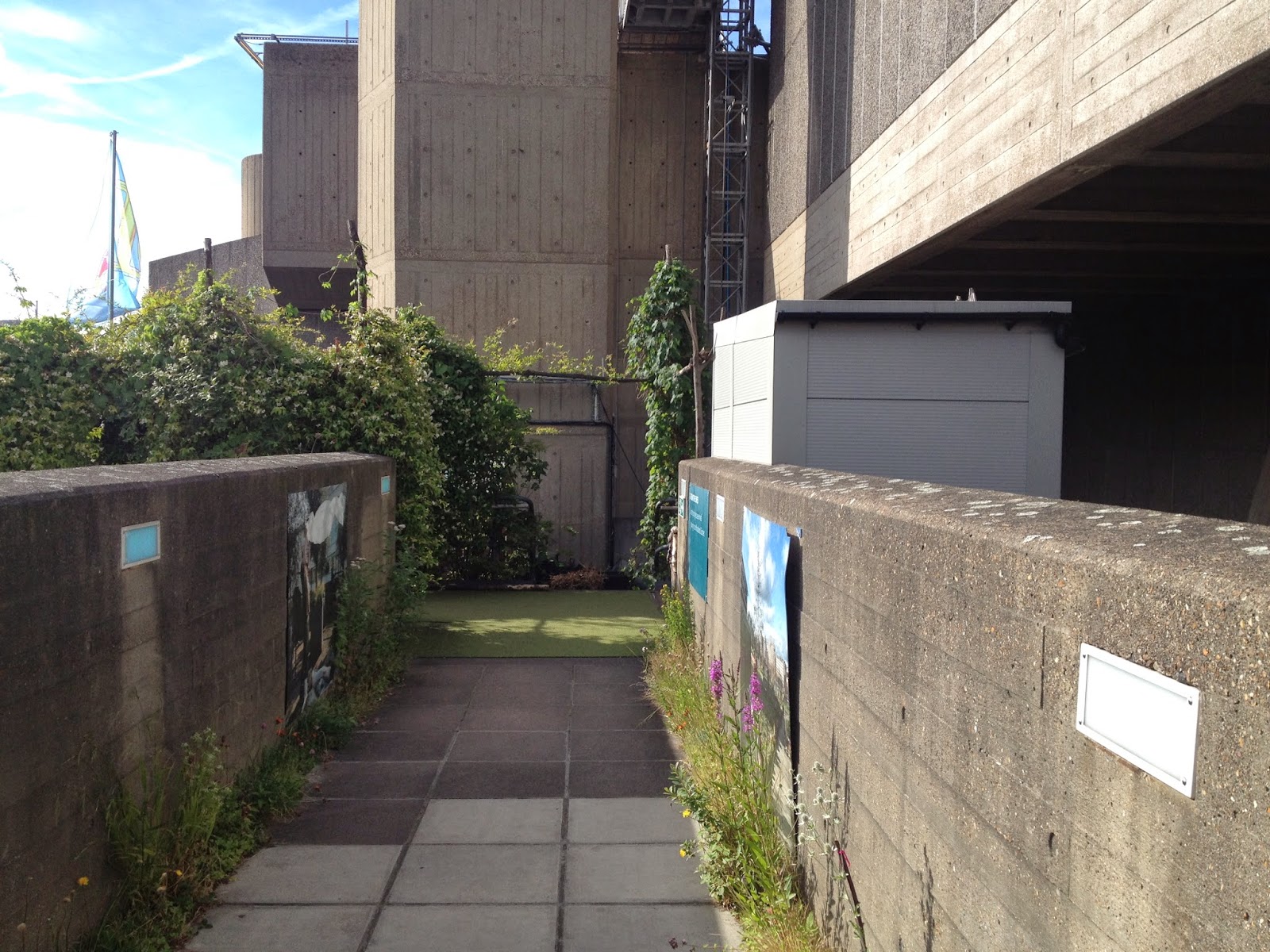
With Frontier in Space out the way on the Pertwee watchathon, it's a visit to the Southbank centre, standing in for a futuristic prison in the 26th century appearing in episode 2.  In recent years access to the upper areas is restricted, but is currently open as a temporary garden and cafe have been opened on the roof.


The establishing shot immediately gives away the location for anyone familiar with the area.  Generally it is largely the same but some walkways have been removed including the one in the foreground.  Various signs make it appear more colourful.


The first scenes are set for the Doctor and Jo being moved from their prison cell and being freed by Draconians.


A longer shot on the walkway, probably the highest publicly accessible.


The Doctor and Jo actually emerge at ground level to the right of the above photos.  A Draconian takes aim...


In the confusion, Jo is separated from the Doctor and runs up some steps on the west of the Hayward Gallery.


Just around the corner she is again captured, a common theme in this story.  Here the steps are heavily obscured by trees as part of the gardens on the roof.

After a forced visit to the Draconian embassy, the Doctor escapes and ends up again in his cell at the Southbank centre.  This time, the Ogrons attack to break them out.


Guards have their attention drawn on the east side of the Hayward Gallery.


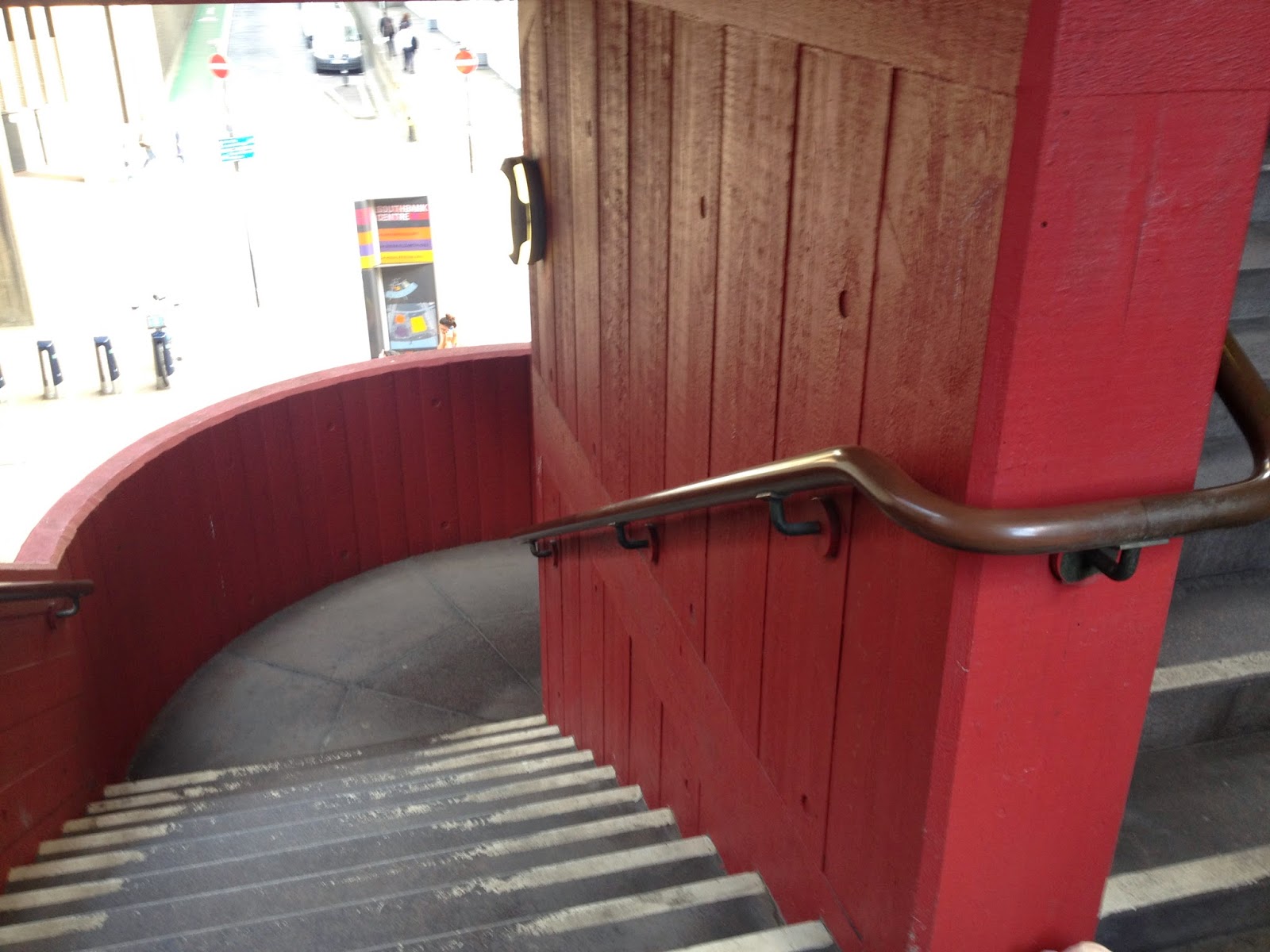
Looking down the steps, now painted bright red, an ogron is seen taking on the shape of a Draconian.


Ogrons bound over the steps...


And attack the west side of the gallery.


Humans wait outside the same steps as seen earlier, when Jo was recaptured, for the Doctor to burst out trying to escape the ogrons.


Lots more garden things fill the scene which is still recognisable, background buildings have changed somewhat.  The Doctor and Jo run down the steps, he points off camera and they run off screen...


To immediately crouch by the very steps they just ran from.  The production tries hard to make the location look much larger and more complex than it actually is.  The Doctor and Jo are again recaptured by the steps.  These steps have been closed off for a number of years but are identifiable behind all the fencing.  Escape, capture, escape, capture, episode two and the start of episode three heavily feature the Southbank centre as a futuristic prison on a fascist Earth.  It's large concrete structure suits the setting perfectly, if being a little obvious as a London landmark.


Sunday, 22 June 2014

Planet of the Giants

Recently I have tried to focus on Hartnells in my introduction of old Dr Who to my girlfriend, some weeks ago I chose Dalek Invasion of Earth.  Last weekend I settled upon Planet of the Giants for various reasons.  Numerous stories are incomplete due to BBC junking, some are very long to fit into a weekend.  Ruling out the simply terrible, like Web Planet or Keys of Marinus, and the interminably dull like the Sensorites there are only a few I particularly would recommend.  The Aztecs and the Romans are good, the War Machines is good but atypical when introducing the Hartnell era.  Planet of the Giants is a bit of an oddity, short, overlooked, yet is entertaining and effective.

Web Planet often held an example of something having huge ambition but failing, as though that in itself makes it worthy of praise when it falls so far short.  Planet of the Giants is very ambitious in other ways and about gets away with it, but seems forgotten because, like the Rescue, it's short and backed up against a much more memorable story.


The first notable thing, is that it's the first contemporary Earth story in Dr Who aside from the opening scenes of Unearthly Child.  It's also around this point that the 'get Ian and Barbara home' theme that underlies the series becomes less important after Giants and Dalek Invasion.  Instead of worrying about getting home as soon as possible, the Tardis crew spend more time adventuring in the past and future, lounging around for weeks prior to the Romans.  They take the opportunity to go in the Chase, but they feel as though they are leaving their second home by this time.  There is no significant historical backdrop to the story or grandiose villains or aliens, which stands it from most other Dr Who stories ever made.  The villains are ordinary humans with a scheme that's fairly small potatoes.  Pesticides killing all the insect life is a serious issue, but the story focuses around the murder to achieve a cover up, which the miniaturised heroes make efforts to foil.


There is some preposterousness in the set up of the story which is so contrived as to make some dismiss the story I suspect.  As with other Hartnells there was more freedom to play with the format, you could have something humorous with the Romans, something very alien with the Web Planet.  Planet of the Giants takes a stab at something different again.  The explanation is 'space pressure' resulting from the Tardis doors inexplicably opening during flight causing them to 'reduce'.  Further, the scanner blows outwards when the crew attempt to view what is outside the Tardis because it's trying to shows 'something too big for it's frame'.  Beyond this, the story is fairly simple, the Tardis crew pick their way up the garden to the house and have to alert the authorities as to the murder.  They encounter various large hazards along the way.  Not being a complex story, it's no great surprise that it was pared down to three episodes from four, but this works as too many other stories are just too long for little content.

Barbara contemplates an oversized Sugar Puff
The story is a simple one, but other aspects of the production appear a high standard.  The model work and inserted backgrounds are great.  There are giant bugs of various kinds, the ant pictured above, a fly that moves a little, a dead worm.  All look good on screen.  Some of the set pieces are very good as well, the oversized seeds, matches and other small items, and larger things like the telephone or the sink make for great scenes.


There's are few cliffhangers like those in Planet of the Giants.  Who would expect one to me turning around to see a cat's face filling the entire screen?  Or another where the peril is derived entirely from someone pulling the plug out of a sink.

A sink empties.  Cliffhangers don't get more tense than this.
All these sets had a good presence on screen, but it would be nothing to achieve these effects today.  They wouldn't impress children at all because 'people getting smaller' is something that has been done many times over.  It was done rather well in Honey, I Shrunk the Kids in 1989, and people roaming around a house encountering large cotton reels and matches was seen in the Borrowers series during the 1990s as well.  Even as far back as the '60s the idea wasn't unique, I recall Steed being shrunk in a black and white episode of The Avengers and the original Incredible Shrinking Man film was as far back as 1957.


The roots of the story were in something about the crew being shrunk in the science classroom of Coal Hill School, which may explain the laboratory theme that remains in Planet of the Giants.  See above as the team try to turn on a bench gas tap.  Overall it's a good story worth taking a second look.  It's a bit of an oddity and often overlooked in favour of more significant stories.  But it's a good Hartnell story with which to introduce someone; it's pleasantly short, all the cast get plenty to do inside only three episodes, there are a series of impressive set pieces and you're always rooting for the team to expose the villains.

Sunday, 1 June 2014

Doctor Who Experience - Cardiff

A couple of months ago I had a chance to visit the Doctor Who Experience in Cardiff Bay as I missed out while it was in London.  The Bay itself has been used many times for filming various New Series and Torchwood episodes, so it's somewhat fitting that the Experience come there.  The price was £13 for adults if booked in advance online, and I'd say on balance that it was worth it given size of the exhibition and the time spent there.  The Experience is split into to sections, the first a walk through interactive part with film of Matt Smith's Doctor talking to the crowd and various things moving and talking.  The section set on the Dalek saucer with a fleet of ships appearing out the window was probably best.  No photos are allowed during this section, so I have none to show and the mystique will remain.  The area of greatest interest was the exhibition of costumes and props that came after.  I'm happy to see that they covered the new and old series as well as having a few unusual treats.


The exhibition seems to be quite up to date, this isn't the original console but a replica made for the Adventure in Time and Space drama shown in November last year.


And the last version of the console seen on the original series with BBC Micros.


A strange auton-like facsimile of the 11th Doctor.


I'm not sure if this is an original Ice Warrior or not.  Not all the costumes in the exhibition are the originals.  Online I have seen a picture of an original Web Yeti but this wasn't present for my visit.


The Giant Robot was one costume I didn't get to see when the Museum of the Moving Image came around the country in about 1993 with Doctor Who monsters.  It really is huge and heavy, being shaped from metal sheet.


Various Cybermen heads, some original and some reproduction as above.


Daleks!  Of all ages, and a mix of genuine and reproduction.  The last in the line outside the picture is one of the larger Moffet-era Daleks.  It towers above the others which just looks odd.  The 60s Daleks look lovely.


A real treat, depending on your feelings for the McGann TV Movie, were the Master's robes.  I assumed these long gone or destroyed, but they have been preserved perfectly.  I took many photos of these for future reference use.


Bessie, just by the exhibition entrance.


There was a museum shop although generally quite expensive, and food being served near the entrance.  We walked into Cardiff Bay to eat there.  If you're in Cardiff and haven't seen the Exhibition yet, it's well worth visiting.